Hydraulic Residential Elevators vs Screw Driven Elevators: Pros and Cons

 English
 Español
 简体中文
简体中文
 Русский
 Árabe
Árabe
 Français
 Deutsch
 Português
 日本語
日本語
 한국어
한국어
 हिंदी
हिंदी
 Prancis
 Türkçe
 Tiếng Việt
 Italiano
 ไทย
ไทย
Hydraulic Residential Elevators vs Screw Driven Elevators: Pros and Cons
September 04, 2025
Understanding the Basics
Hydraulic elevators and screw driven elevators are two of the most popular choices for homes.
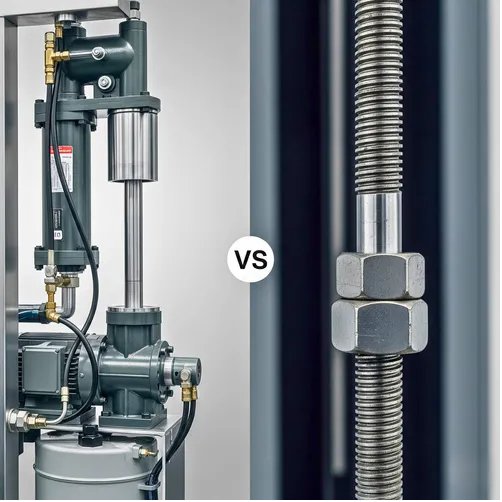
Hydraulic elevators lift the car using a pump that pushes oil into a cylinder. The pressure raises or lowers the platform smoothly.
Screw driven elevators use a motor that turns a screw inside the shaft. A nut attached to the screw moves the car up and down.
Both systems are reliable but they work differently and suit different needs. If you want to see how screw systems are applied in homes, explore our screw driven elevators.
Hydraulic Elevators: Pros and Cons
Pros
Smooth and quiet ride due to hydraulic fluid movement.
Strong enough to carry heavier loads and suitable for homes with multiple floors.
Often cheaper to install compared to other lift types.
Cons
Oil leaks can happen and may damage flooring or walls.
Regular maintenance is required which can increase long term costs.
Needs more space, sometimes including a pit or machine room.
Less energy efficient because the pump consumes more power.
Hydraulic systems are better for larger homes, but keep in mind they demand extra space. If your home is smaller, consider compact residential elevators as an alternative.
Screw Driven Elevators: Pros and Cons
Pros
Simple design with fewer moving parts which reduces maintenance needs.
Compact structure that does not require a deep pit or machine room.
Cost effective for installation and long-term use.
Runs smoothly and safely with a self-locking system that keeps the car secure.
Cons
Moves slower compared to hydraulic systems which may feel less convenient.
Slightly noisier mechanically, although not disturbing in most homes.
Limited load and height capacity, making them best for low rise residential buildings.
For households that want reliability and safety in tight layouts, small residential elevators are a practical fit.
Comparison at a Glance
Feature | Hydraulic Elevator | Screw Driven Elevator |
|---|---|---|
| Installation Cost | Lower initial cost | Low to moderate depending on model |
| Space Requirements | Needs more room for machinery and pit | Very compact with minimal construction |
| Maintenance | Higher, requires oil checks and servicing | Lower, fewer parts and simple upkeep |
| Load Capacity | Suitable for heavy loads | Better for lighter residential loads |
| Ride Comfort | Very smooth and quiet | Smooth but slower movement |
| Reliability | Risk of oil leaks | Reliable with self locking design |
| Best Fit | Larger homes with more usage | Space conscious homes with limited floors |
If you want proof of how these systems perform in real homes, check our case studies for examples.
Choosing the Right Option
A hydraulic elevator is a good choice if your home has more space and you need stronger lifting capacity. It works well for larger households or frequent use.
A screw driven elevator is the better option if saving space, easy maintenance, and long term reliability matter most. It is ideal for modern homes where installation space is limited. To understand how we maintain safety and performance, take a look at our quality control process.
Conclusion
Both hydraulic and screw driven elevators have their strengths. Hydraulic systems are powerful and smooth but need more space and maintenance. Screw driven elevators are compact, energy efficient, and easy to care for, making them perfect for homes that value simplicity and safety.
If you want a lift that combines convenience with reliability, screw driven elevators are often the smarter choice for modern residential settings.
latest company news
Mail Us



-
About
-
Screw Driven Elevator
-
Small Residential Elevator
-
Follow Us
Binhe Industrial Park, Huihe Street, Jiyang District, Jinan, Shandong, China
+8618654341166
ystelevator@yeah.net
-
Mail Us
China Good Quality Screw Driven Elevator Supplier. © 2025 - 2026 Shandong YST Elevator Co., Ltd.. All Rights Reserved.
